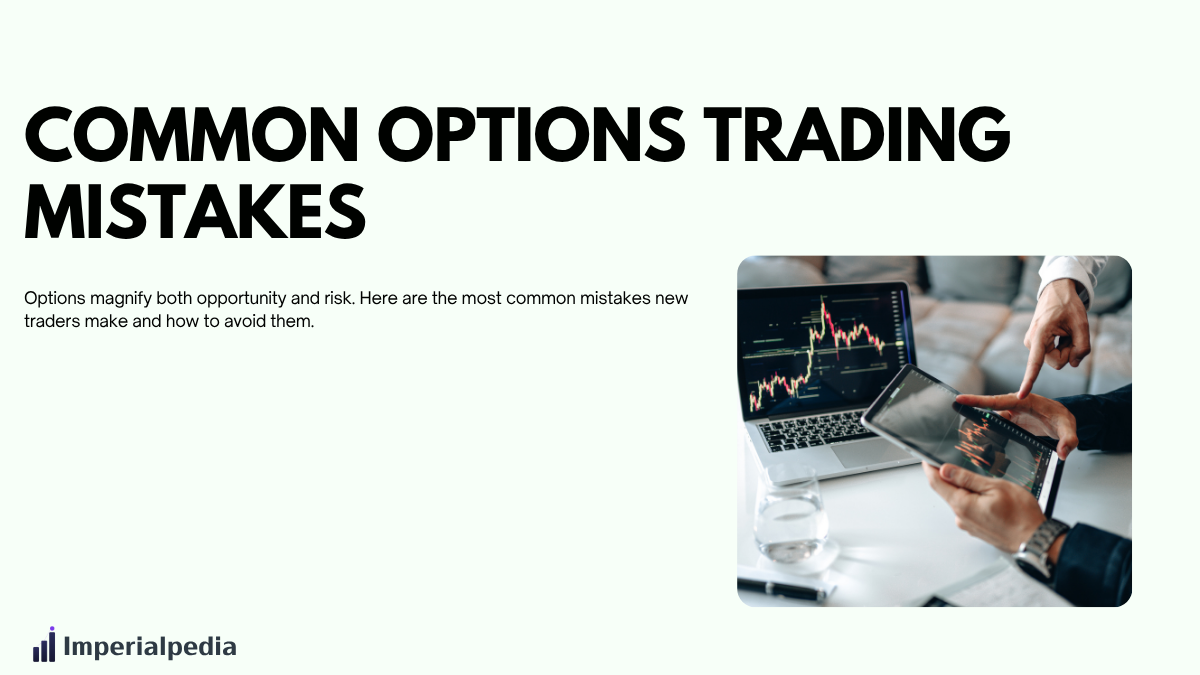
Options can be powerful tools, but they punish carelessness quickly. Recognizing these common options trading mistakes in advance can help you avoid costly, avoidable errors.
Mistake 1: Ignoring Time Decay
Many new traders focus solely on whether the underlying asset moves in their expected direction, forgetting that theta — time decay — is constantly working against option buyers. An option can lose value even if the underlying eventually moves favorably, simply because the move happened too slowly relative to time remaining until expiration.
Mistake 2: Overleveraging Positions
Options allow you to control significant exposure with a relatively small amount of capital, which is part of their appeal — and part of their danger. Risking too large a portion of your account on a single position means one adverse move can cause outsized damage that's difficult to recover from.
Mistake 3: Selling Uncovered Options Without Understanding the Risk
Selling (writing) calls or puts without owning the underlying asset or otherwise limiting your risk can expose you to potentially very large losses if the market moves sharply against your position. New traders sometimes focus on the premium income received without fully internalizing this downside exposure.
Mistake 4: Trading Illiquid Contracts
Not every options contract trades frequently. Illiquid contracts often have wide bid-ask spreads, meaning the price you pay to enter and the price you receive to exit can differ significantly from the option's theoretical fair value — quietly eroding your potential profit or magnifying losses.
Mistake 5: No Clear Exit Plan
Entering a trade without predefined criteria for taking profits or cutting losses often leads to emotional decision-making. Traders may hold losing positions too long, hoping for a reversal, or exit winning positions prematurely out of fear — both of which undermine a disciplined strategy.
Mistake 6: Misunderstanding the Greeks
Focusing only on the underlying asset's price direction, while ignoring theta (time decay), vega (volatility sensitivity), and gamma (how quickly delta changes), leaves traders blind to significant forces affecting their position's value. Reviewing our guide on the option Greeks can help close this gap.
Mistake 7: Chasing High Premiums Without Understanding Why
An unusually high premium often reflects elevated implied volatility or perceived risk. Chasing these premiums as "easy income" without understanding the underlying risk can lead to underestimating potential losses.
A Practical Checklist
| Before every trade, ask | Why it matters |
|---|---|
| What is my maximum possible loss? | Prevents unpleasant surprises |
| How does time decay affect this position? | Buyers need the move to happen quickly enough |
| Is this contract liquid enough to exit easily? | Avoids poor execution pricing |
| What is my exit plan for both profit and loss? | Reduces emotional decision-making |
Conclusion
Most options trading mistakes stem from underestimating risk — whether from time decay, leverage, uncovered positions, or a lack of planning. Understanding these pitfalls in advance, and building basic risk-management habits before ever placing a trade, is one of the most valuable steps any options trader can take.