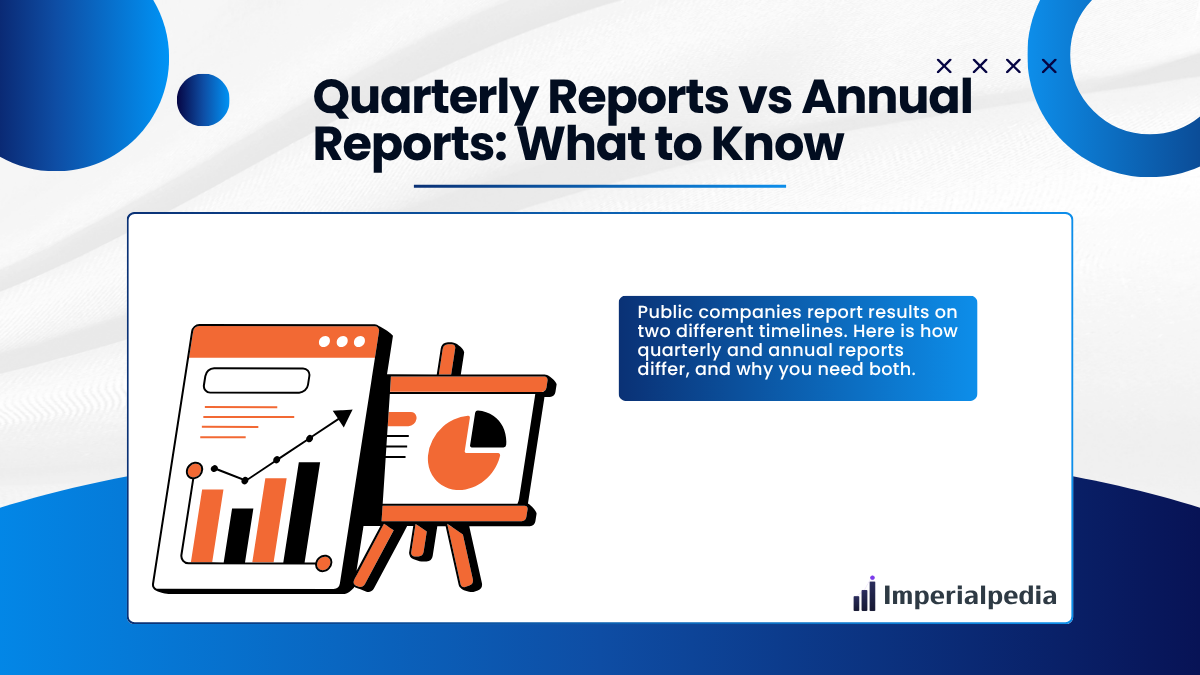
Public companies do not report their financial results just once a year — they report on two overlapping timelines. Understanding quarterly reports versus annual reports helps investors know which document to reach for and what to expect from each.

Two Layers of Corporate Reporting

In the United States, publicly traded companies are required to regularly disclose their financial results to securities regulators. This happens through two primary filing types, both accessible through the SEC's EDGAR database:

  • Form 10-Q — filed quarterly, covering a three-month period.
  • Form 10-K — filed annually, covering the full fiscal year.

Together, these filings form the backbone of what most people mean when they refer to a company's earnings report, released on a predictable rhythm during earnings season.

What a Quarterly Report (10-Q) Contains

The 10-Q provides a snapshot of a company's performance over the most recently completed quarter. It typically includes:

  • Unaudited financial statements — income statement, balance sheet, and cash flow statement.
  • Management's discussion and analysis of the quarter's results.
  • Updates on material risks or legal proceedings since the last filing.

Because quarterly reports are unaudited, they are prepared more quickly than annual reports, giving investors a timelier — though somewhat less exhaustively verified — view of performance.

What an Annual Report (10-K) Contains

The 10-K is significantly more comprehensive. It includes:

  • Audited financial statements for the full fiscal year, reviewed by an independent auditor.
  • A detailed description of the company's business, strategy, and competitive landscape.
  • Extensive risk factor disclosures.
  • Executive compensation details and corporate governance information.

Because U.S. companies typically file three 10-Qs per year, the fourth quarter's standalone results are not filed as a separate 10-Q — they are incorporated into the full-year 10-K instead.

Comparing the Two

FactorQuarterly Report (10-Q)Annual Report (10-K)
FrequencyThree times per yearOnce per year
Audit statusGenerally unauditedIndependently audited
DepthFocused, conciseComprehensive, detailed
Risk disclosuresUpdates since last filingFull, detailed risk factors
Business overviewBrief updatesFull strategic and competitive overview

Why You Need Both

Quarterly reports give you a frequent pulse check on how a business is trending in the near term — useful for spotting emerging patterns in revenue and earnings well before the year closes. Annual reports give you the deep, audited context needed to understand the full-year trajectory, long-term risks, and management's strategic priorities. Relying on only one leaves real gaps: quarterly reports alone can miss the broader strategic picture, while annual reports alone leave you a full year behind on emerging trends.

Comparing results both quarter-over-quarter and year-over-year — using the same quarter from the prior year — helps account for seasonal patterns that many businesses naturally experience.

How These Filings Fit Into Earnings Season

Every quarterly earnings release is effectively the announcement layer sitting on top of the underlying 10-Q or 10-K filing. The press release and earnings call give investors a fast, digestible summary of results and guidance, while the formal SEC filing that follows contains the full, legally required detail behind those headline numbers. Companies typically release the summary first, with the detailed filing following within a short window afterward, so it is worth checking both rather than treating the press release alone as the complete picture.

Common Mistakes

  • Reading only quarterly headlines without ever reviewing the fuller annual risk disclosures.
  • Comparing a quarter directly to the prior quarter without accounting for seasonality, instead of comparing it to the same quarter a year earlier.
  • Assuming quarterly figures are audited with the same rigor as annual figures.
  • Overlooking the annual report's risk factors section, which often contains the most candid discussion of what could go wrong.
  • Treating the earnings press release as a substitute for the full 10-Q or 10-K filing.

Conclusion

Quarterly and annual reports serve complementary roles: one keeps you current, the other keeps you grounded in the full picture. Learning to read both — and to understand what level of detail and verification each one offers — is a foundational skill covered throughout our complete guide to earnings reports.